×
- Hello
- Login or Register
- Quick Links
- Live Chat
- Track Order
- Parts Availability
- RMA
- Help Center
- Contact Us
- Shop for
- Honda Parts
- Honda Accessories

My Garage
My Account
Cart
Genuine Honda CRX Alternator
Generator- Select Vehicle by Model
- Select Vehicle by VIN
Select Vehicle by Model
orMake
Model
Year
Select Vehicle by VIN
For the most accurate results, select vehicle by your VIN (Vehicle Identification Number).
14 Alternators found
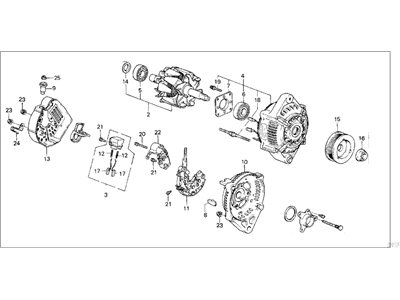
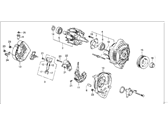
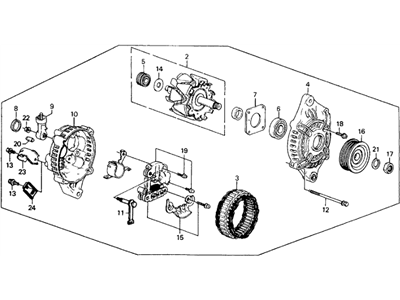
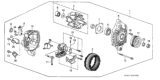
Honda CRX Alternator Assembly (Cha22) (Denso)
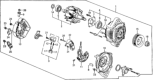
Part Number: 31100-PE1-663$170.98 MSRP: $246.90You Save: $75.92 (31%)Honda CRX Alternator Assembly (Reman) (Denso)
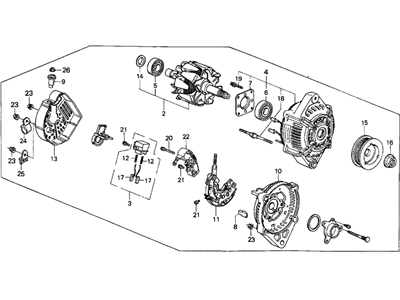
Part Number: 31100-PE7-661RMD$218.89 MSRP: $316.32You Save: $97.43 (31%)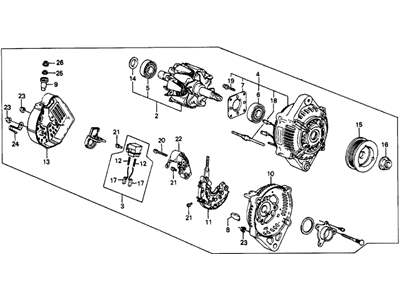
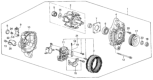
Honda CRX Alternator Assembly (Cha08) (Reman) (Denso)
Part Number: 31100-PE0-003RM$155.27 MSRP: $224.12You Save: $68.85 (31%)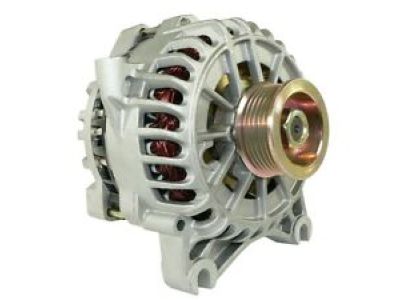
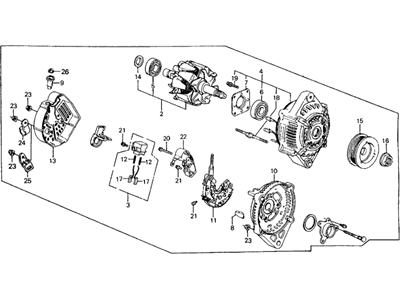
Honda CRX Alternator
The alternator is one of the essential parts of the car, as well as it charges the battery and supplies power to the vehicle electrical system whilst traveling. It functions by converting mechanical energy in the form of engine output energy to electrical energy mostly in the AC format that requires to be rectified to DC format required to recharge battery and for powering parts. The usual make of the Honda CRX alternators is the two-piece cast aluminum housing, which contains a stator and rotor assembly. The rotor which is coupled with the help of a belt from the engine produces a magnetic field in which voltage is induced in the stator coils. From time to time will vary of alternator design: differences in excitation, for example, field coils or permanent magnets to the use of contemporary voltage regulation, and known that modern alternators may be included in the Transition Control Module (PCM). For those with higher electrical loads, high output alternators are provided for additional charging options to guarantee reliability of Honda CRXs.
In search of affordable OEM Honda CRX Alternator? Consider browsing through our extensive inventory of genuine Honda CRX Alternator. Not only do we provide market-leading prices and a manufacturer's warranty, but we also pride ourselves on exceptional customer service and swift delivery.
Honda CRX Alternator Parts Questions & Experts Answers
- Q:How does the alternator convert mechanical energy into electrical energy and what are the key components and precautions involved in its operation on Honda CRX?A:When the drive belt moves, it turns an electrical current through magnetically induced energy. When you switch on the ignition, electricity starts from the battery, passes through the Voltage Regulator, and ends up in the alternator. The diode rectifier changes the rotating motion of the drive belt into alternating current in the stator, which becomes direct current as it flows through the rotor. Most electricity goes to both charge the battery and run the car's electric systems. Some remains in the field wires to make the generator produce more energy. For cars with air conditioning, the alternator sits on a specialized mount, installed close to the number one front spark plug in the engine cavity. Take these steps: check the battery's positive and negative connections, wire up booster batteries right, don't use fast charging, disconnect battery cables before charging, and keep all connections clean and securely fastened. The belt should hold 22 pounds of pressure to shift by 0.35-0.43 inches when the belt is worn out, while a fresh belt needs 0.25-0.35 inches of movement under the same pressure. Take these steps to remove the alternator: disconnect the car's negative battery cable, remove the air cleaner if there's one, unplug all electrical connections, flip the adjusting bolt, take off the belt that turns it, and remove the whole thing. When changing brushes, you need a special iron that uses a soldering that has rosin in it. You also measure the brush lengths and put the new ones on right. To replace brushes in a Mitsubishi alternator, you first take out the whole assembly, open the front half of the unit, test brush length, and then put everything back together before reinstalling.