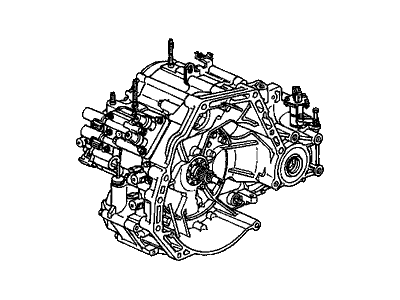
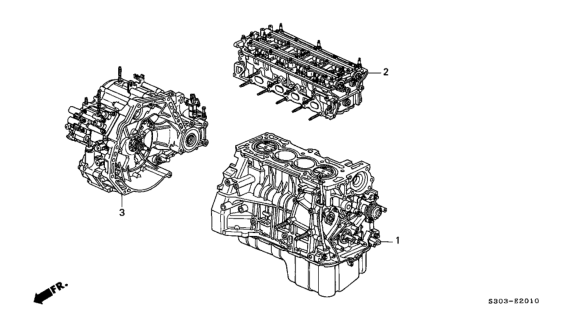
Disconnect the negative and then the positive battery cables from the battery, shift the transaxle into N, remove the battery hold-down and battery, drain the transaxle fluid and reinstall the drain plug with a new crush washer, remove the air intake duct, air cleaner case, and resonator, disconnect the connector from the vacuum tank and remove the vacuum tank and tank bracket without removing the vacuum lube, disconnect the transaxle-to-body ground cable, remove the battery base with the ground cable and battery base stay, disconnect the lock-up control solenoid valve and shift control solenoid valve connectors, disconnect the throttle control cable from the throttle control lever, detach the Counter shaft Speed Sensor connector, unplug the Vehicle Speed Sensor connector, remove the rear stiffener, then remove the Vehicle Speed Sensor and Power Steering Speed sensor without disconnecting the power steering pressure hoses, disconnect the ATF cooler hoses at the joint pipes while turning the ends of the cooler hoses upward to prevent fluid loss and plug the joint pipes, remove the starter motor, upper transaxle housing mounting bolts, loosen the front engine mount bracket bolts, remove the transaxle mount, raise and support the vehicle safely, remove the front wheels, remove the splash shield, subframe center beam, and rear beam stiffener, remove cotter pins and castle nuts from the lower ball joints using a press-type ball joint tool to separate the ball joints from the lower arm, remove the damper fork bolts and separate the damper fork and damper, use a suitable pry tool to separate the right and left halfshafts from the differential, pull on the inboard joint and remove the right and left halfshafts while tying plastic bags over the halfshaft ends to protect the boots and splined shafts, remove the right damper pinch bolt and separate the right damper fork from the strut, remove the right radius rod bolts and nut, remove the radius rod, remove the torque converter cover and shift cable cover, remove the control lever lock bolt and shift cable with the lever without bending the shift control cable, wire the cable to the underbody of the vehicle out of the work area, remove the driveplate bolts while rotating the crankshaft, place a transaxle jack below the transaxle and raise it enough to take the weight off the mounts, remove the intake manifold bracket, lower transaxle housing mounting bolts, and lower rear engine mounting bolts, pull the transaxle away from the engine until it clears the dowel pins, and lower the transaxle out of the vehicle. For installation, use new self-locking nuts for the front suspension components, new set rings on the halfshaft inboard joints, and new self-locking bolts for the subframe beams, available from a Honda dealer, flush the transaxle cooling lines before installing the transaxle using a pressurized flushing canister with biodegradable flushing fluid, fill the flusher with 21 ounces of fluid, pressurize to 80-120 PSI, clamp the discharge hose to the cooler return line, clamp the drain hose to the cooler inlet line, connect the flusher to air and water lines, open the flusher water valve and flush the cooler for ten seconds, depress the flusher trigger to mix flushing fluid with water, flush for two minutes, reverse the hose and flush in the opposite direction, dry the cooler lines with compressed air, install the starter motor onto the transaxle case, install the torque converter with a new hub O-ring, tighten the starter bolts to 33 ft. lbs., place the transaxle on a transaxle jack and raise it to the level of the engine, align the transaxle to the engine and install the transaxle housing mounting bolts and lower rear engine mounting bolts, tighten the rear engine mounting bolts to 40 ft. lbs. and the transaxle mounting bolts to 47 ft. lbs., install the intake manifold bracket and tighten the bolts to 16 ft. lbs., tighten the front engine mount bracket bolts to 28 ft. lbs., install the transaxle mount and tighten the bolt to 47 ft. lbs. and the nuts to 28 ft. lbs., remove the transaxle jack, attach the torque converter to the driveplate and install the mounting bolts, turn the crankshaft to rotate the driveplate, tighten the bolts in two steps, first to 4.5 ft. lbs. in a crisscross pattern and finally to 9 ft. lbs., check for free rotation after tightening the last bolt, install the shift cable onto the control shaft and tighten the lock bolt to 10 ft. lbs., install the torque converter cover and shift cable cover, install a new set ring onto the inboard joint of each halfshaft, install the damper fork bolts and ball joint nuts to the lower arms, tighten the ball joint nut to 47 ft. lbs. and install a new cotter pin, install the radius rod and connect the damper fork while only hand-tightening the radius rod and damper fork fasteners, turn the right steering knuckle fully outward and slide the axle into the differential until the spring clip engages the differential side gear, repeat on the left side, install the subframe rear beam stiffener and center beam, tighten the stiffener bolts to 28 ft. lbs. and the subframe center beam bolts to 43 ft. lbs., install the front wheels and lower the vehicle, use a floor jack to place the weight of the vehicle onto the right front knuckle, tighten the radius rod bolts to 76 ft. lbs. and the nut to 40 ft. lbs., tighten the damper pinch bolt to 32 ft. lbs., tighten the nut to 47 ft. lbs. while holding the damper fork bolt, remove the floor jack, install the speedometer sensor and tighten the sensor bolt to 9 ft. lbs., connect the ATF cooler hoses to the joint pipes, connect the lock-up control solenoid and shift control solenoid valve connectors, attach the VSS and PSS sensor connectors, connect the starter motor cables and install the battery base and base stay, connect the ground cables on the body and transaxle, install the vacuum tank, tank bracket, and connect the tank connector, install the resonator, air cleaner case, and air intake duct, refill the transaxle with ATF using only Honda Premium ATF or an equivalent DEXRON II ATF, connect the negative and positive battery cables, leave the flusher drain hose attached to the cooler return line, with the transaxle in park, run the engine for 30 seconds or until approximately one quart of fluid is discharged, remove the drain hose and reconnect the cooler return line, refill the transaxle to the proper level with ATF, start the engine, set the parking brake, and shift the transaxle through all gears three times, check for proper control cable adjustment, on Preludes equipped with 4WS, turn the steering wheel lock-to-lock to reset the steering control unit, check and adjust the front wheel alignment, let the engine reach operating temperature with the transaxle in N or P, then turn the engine off and check the fluid level, after road testing the vehicle, loosen the front engine mount bolts and tighten them to 28 ft. lbs., and enter the radio security code. For shift linkage adjustment, remove the lower right steering column access hole cover, shift the transmission to N, remove the shift cable end lock pin from the adjustable cable end, check the alignment of the hole in the cable end with the linkage adjusting rod, if not aligned, loosen the cable end lock nut and adjust until aligned, reinstall the lock pin, ensure the lock pin snaps firmly into place, move the gear selector through each gear position and verify the operation of the gear position indicators, insert the ignition key into the key cylinder on the upper steering column cover and check that the shift lock lever releases. For throttle linkage adjustment, start the engine and allow it to run in P at 3,000 RPM until the radiator fan comes on, then allow the engine to idle, check the throttle cable side-to-side deflection, which should be 3/7-1/2 inches, and if not within specification, loosen the locknut and adjust the throttle cable as necessary.