×
- Hello
- Login or Register
- Quick Links
- Live Chat
- Track Order
- Parts Availability
- RMA
- Help Center
- Contact Us
- Shop for
- Honda Parts
- Honda Accessories

My Garage
My Account
Cart
Genuine 2002 Honda Passport Camshaft
Cam- Select Vehicle by Model
- Select Vehicle by VIN
Select Vehicle by Model
orMake
Model
Year
Select Vehicle by VIN
For the most accurate results, select vehicle by your VIN (Vehicle Identification Number).
3 Camshafts found
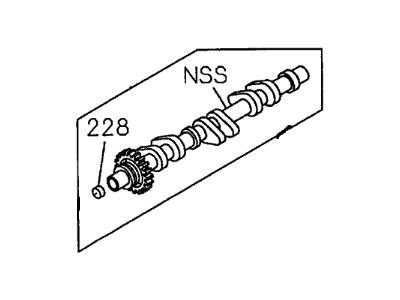
 Product Specifications
- Other Name: Intake Camshaft
- Position: Driver Side
- Replaces: 8-97131-946-0
- Item Weight: 4.80 Pounds
- Item Dimensions: 18.4 x 4.1 x 4.2 inches
- Condition: New
- Fitment Type: Direct Replacement
- SKU: 8-97131-946-1
- Warranty: This genuine part is guaranteed by Honda's factory warranty.
- Product Specifications
- Other Name: Intake Camshaft
- Replaces: 8-97131-944-0
- Item Weight: 4.90 Pounds
- Item Dimensions: 18.2 x 3.6 x 3.4 inches
- Condition: New
- Fitment Type: Direct Replacement
- SKU: 8-97131-944-1
- Warranty: This genuine part is guaranteed by Honda's factory warranty.
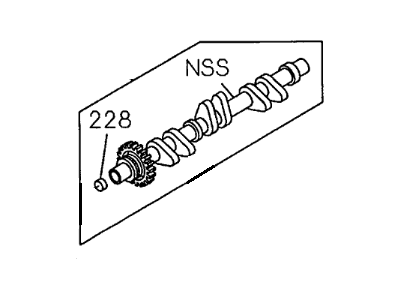 Product Specifications
- Other Name: Exhaust Camshaft
- Replaces: 8-97148-506-0, 8-97136-139-0
- Item Weight: 4.80 Pounds
- Item Dimensions: 20.3 x 3.1 x 3.0 inches
- Condition: New
- Fitment Type: Direct Replacement
- Require Quantity: 2
- SKU: 8-97136-139-1
- Warranty: This genuine part is guaranteed by Honda's factory warranty.
2002 Honda Passport Camshaft
Our website is the optimal online store for when you need any genuine 2002 Honda Passport Camshaft. We offer a wide range of 2002 Honda Passport Camshaft at unbeatable prices. We will help provide you with a worry-free shopping experience at highly competitive prices. In addition, all OEM parts are backed by the manufacturer's warranty.
2002 Honda Passport Camshaft Parts Questions & Experts Answers
- Q:What steps should be taken to inspect and prepare the engine block and camshaft for potential repairs or replacements on 2002 Honda Passport?Posted by Ryo M.A:Before conducting the block inspection it should be cleaned, the ridge at the top of each cylinder must be scraped off completely. When inspecting visually look for cracks, rust and corrosion, also look for stripped threads in the threaded holes. This, however, is well-advisable done after ensuring the block has no concealed crack(s) best done by a machine shop equipped with the right tools. If each of these is present or there are signs of any of these, then repair or replace the block as required. Examine the cylinder bores for signs of scuffing and scoring; see Table 7 for the dimensions of cylinder bores. The taper is calculated on the basis of the variation in the outer and inner bore diameter and the out-of-round is the variation between the parallel and perpendicular measurements. Do the same for the other pistons and cylinders-if there is any leakage, bad compression means there will be no combustion to contain the leak. In as much as the cylinders as reconditioned and within the required limits, simpler processes such as honing may be adequate to avoid a rebore. To measure the block deck for distortion, use a precision straight and a feeler gauge; if they are off limits, resurfacing is needed. The bearing journals on the camshaft also have to be checked for wear, pitting or seizure after which they have to be cleaned. Some journals appear having been grotesquely twisted and this suggests that the bearing inserts or the camshaft towers might also be spoiled which would then require replacement of both the camshaft and its bearings. With a micrometer, check the bearing journals to the extent that it may be worn or out of round. The camshaft lobes should be checked for signs of discoloration, scorer or other shows of wear; assuming that the lobes are acceptable the camshaft can be reused. For 3.1L V6 engines, clean the lifters and visually inspect them for wear and, if new lifters are fitted, a new camshaft must always be fitted. In four-cylinder engines the camshaft is situated between the cylinder head and caps; to measure the amount of clearance Plastigage can be used. The camshaft is seated in towers in the case of 3.2L V6 engines; the amount of oil clearance is arrived at when the bore and the journal diameter have been determined. In either case, excessive clearances will lead to the replacement of the camshaft, or cylinder heads.Answered by Honda Parts Specialist Jeremie / May 24, 2025
Related 2002 Honda Passport Parts
 2002 Honda Passport Timing Cover
 2002 Honda Passport Cylinder Head Gasket
 2002 Honda Passport Cylinder Head
 2002 Honda Passport Crankshaft Pulley
 2002 Honda Passport Crankshaft
 2002 Honda Passport Crankshaft Gear